PhsarOS
Point-of-Sale & operations dashboard for small retailers
What this proves
I can design a relational schema and enforce data integrity with atomic transactions and server-side validation end-to-end — the core signal for backend capability.
Problem
Small retailers need a fast, atomic point-of-sale system connected to a live operations dashboard without the enterprise bloat. They often resort to pen and paper because existing tools are slow, overly complex, or require expensive hardware.
My role
I engineered the entire platform end-to-end. I designed the multi-tenant schema, built the transactional checkout, and developed the type-safe UI.
What I built
- — Live operations dashboard with KPIs, a 7-day revenue chart, and recent sales
- — Point of Sale with a searchable grid, mobile order bar, and bottom order sheet
- — Atomic transactional checkout with real-time change calculation
- — Inventory management with bottom-sheet forms and mobile card layouts
- — Mobile-first shell: top status bar + bottom tab nav
- — Persistent night mode: app-level theme controller with dark tokens across every route
- — A server-rendered dashboard (React Server Component) so data lands in the first paint with a skeleton, not a loading flash
- — Accessible drawers and modals: focus trap, Escape-to-close, and ARIA dialog roles
Architecture
PhsarOS is a Next.js 14 App Router app where the backend is expressed as type-safe Server Actions calling Prisma against Neon serverless Postgres, avoiding a separate REST/GraphQL layer. The checkout path is deliberately modeled as one Prisma transaction so a sale, its line items, and stock decrements either all commit or all roll back — chosen over offline-first capability as the priority tradeoff. A Prisma driver-adapter setup lets the same schema run on SQLite locally and Neon in production by swapping a single adapter, and the dashboard uses React Server Components so KPI data is present at first paint rather than after a client fetch.
A Vercel-hosted dashboard backed by Neon Postgres serverless. It uses a custom design-token system, optimistic UI, and keyboard-first navigation for rapid cashier workflows.
Backend / deployment
- Status
- Live demo
- Frontend
- Next.js 14 (App Router, React Server Components) on Vercel
- Backend
- Next.js Server Actions with Prisma 7
- Database
- Neon serverless Postgres (Prisma driver adapter)
- Hosting
- Vercel
Built on Vercel + Neon Postgres + Prisma server actions; the hosted demo instance is currently being fixed.
Backend-adjacent proof
- — Transactional checkout executed as a single Prisma transaction (sale + sale items + stock decrement) for data integrity.
- — A relational schema of 7 Prisma models designed multi-tenant-ready.
- — Server-side Zod validation enforced on every mutation.
- — Type-safe Server Actions used instead of hand-rolled REST/GraphQL endpoints.
- — Neon serverless Postgres connected through a swappable Prisma driver adapter (SQLite → Neon by changing one adapter).
- — A server-rendered dashboard (React Server Component) so data lands in the first paint.
- — A daily self-reset cron job that resets the public demo database.
Stack
Constraints
- — Must be keyboard-first for rapid cashier workflows
- — Checkout must be a single atomic transaction
- — Needs a multi-tenant-ready relational schema
Tradeoffs
- — Prioritized atomic transactions over offline-first capability
- — Used Next.js App Router which adds some hydration complexity but significantly speeds up server-side data fetching
What It Demonstrates
- 7 application routes backed by 7 relational Prisma models
- Lightning-fast ~88-101 kB first-load JS across operations routes
- Production build passes strict lint and type-check
What I learned
- — Type-safe end-to-end development via Server Actions (eliminating REST/GraphQL boilerplate)
- — Executing checkout as a single Prisma transaction (sale + items + stock decrement)
- — Server-side Zod validation on every mutation
- — Driver-adapter architecture: swapped SQLite for Neon Postgres by changing a single adapter
- — Building responsive, mobile-first touch interfaces with Tailwind CSS
- — Implementing a robust light/dark theme token system across a complex dashboard
Next backend step
Repair the hosted demo instance (fix the failing runtime/DB env so the public URL serves the dashboard again), then add authenticated multi-tenant scoping and audit logging on top of the existing schema.
Visual archive

Live dashboard: today's sales & expenses, low-stock alerts, and a 7-day revenue trend
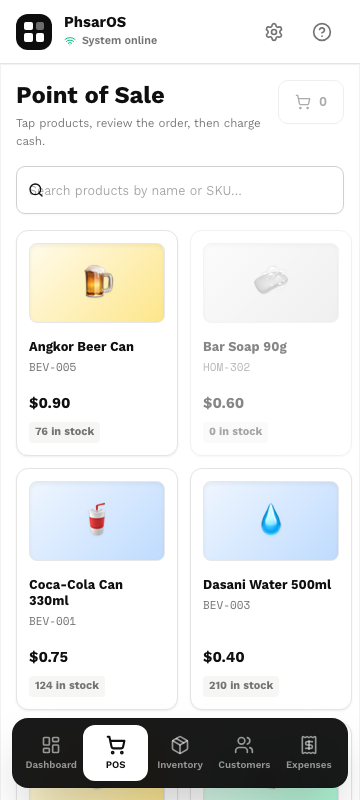
Mobile-first POS: searchable grid, bottom tab nav, and transactional tap-to-add checkout flow

Persistent night mode: app-level theme controller applying dark tokens to the shell and charts
Responsive dashboard scaling perfectly to a 360px phone screen
Inventory management with per-product low-stock thresholds and status badges
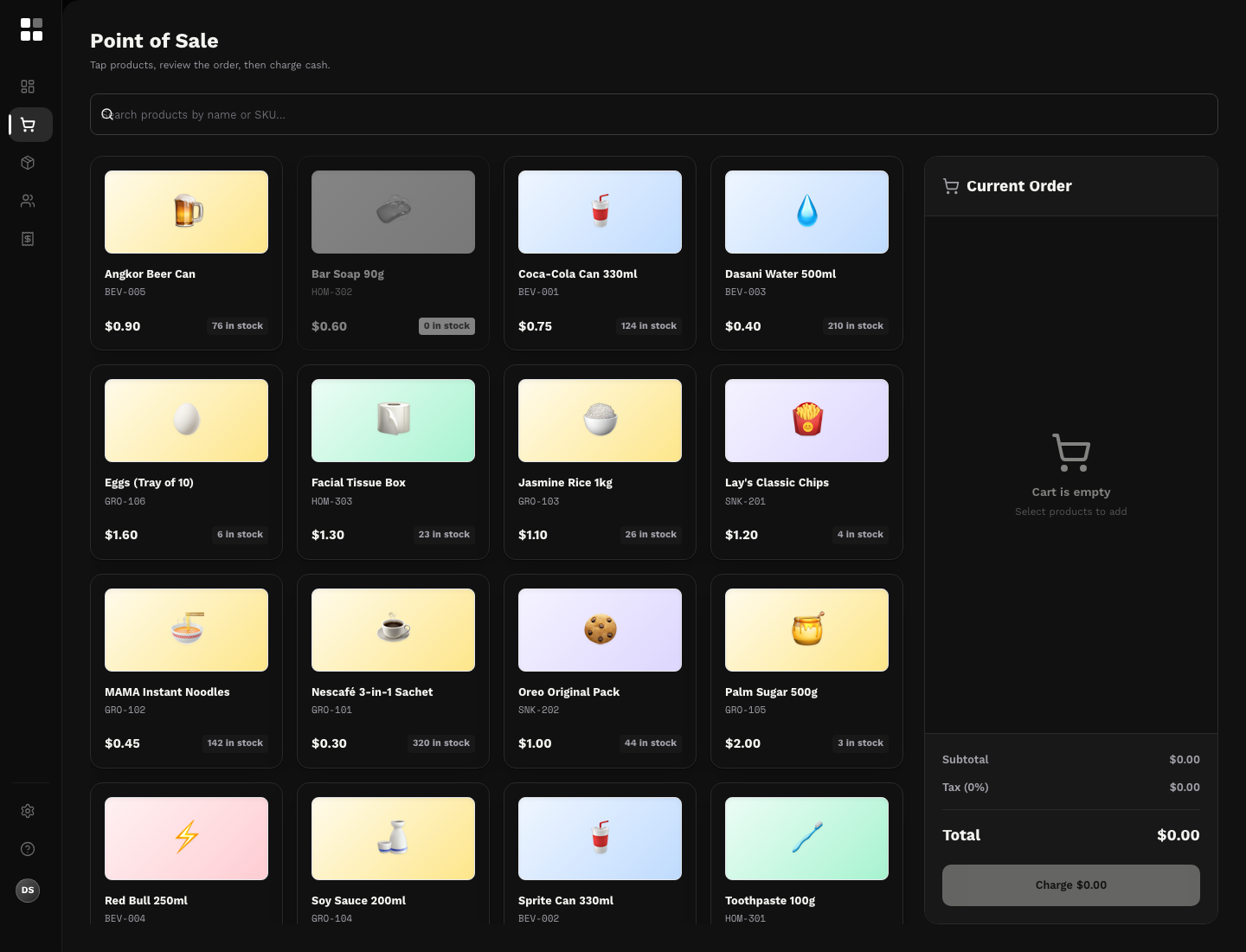
High-contrast dark mode for the POS terminal
Working on something similar?
Let's talk →